
Over 50,000 merchant ships navigate across the oceans daily. Many, if not all, of these cross the oceans under extremely hazardous environments where a small oversight in terms of navigation or communication could lead to major catastrophes. According to a recent International Maritime Organization (IMO) report, 80% of maritime incidents take place because of human error, and nearly half of them result from communication failures.
A major cause is poor communication, such as a misunderstanding, ambiguous instructions, or a lack of clarity in communication. Even a small misinformation or failure in onboard communication systems may raise concerns related to the safety of the crew, delays in operations, or may turn damage into a disaster. Thus, ensuring effectiveness in marine internal communication and coordination devices is not only necessary but a mandatory regulatory compliance.
To achieve this, the outdated analog marine communication systems, such as two-way radios, sound-powered systems, and public address (PA) systems, have been replaced with the modern integrated IP-based systems. With features like real-time navigation and connectivity, improved audio communication channels, and encrypted communication for security, these systems enhance the internal communication system for ships.
Read on to explore the latest advancements in the marine onboard communication systems, as well as the technologies transforming the internal communication systems for ships. Also, learn about the internal ship communication Edge In Control – A leading digital integrated internal communication system (EICS), tailored specifically for inconsistent marine environments.
Types of Marine Internal Communication Systems
To establish an efficient internal communication system inside a vessel, several subsystems serving individual functions are connected together to perform as a single comprehensive ship communication system.
The marine internal communication systems can be classified on the basis of their functionality or technologies used:
Intercom Systems
The marine intercom systems establish point-to-point and point-to-all internal communication in the vessel. They allow for quick and direct voice communication between specific stations. A vessel’s intercom setup forms a linked network of stations. This system includes a Main Station, Sub-stations, Handsets and Mics, Speakers, Wiring or Network, and a Central Unit or Exchange.
- The intercom systems between the bridge and the engine room are used to communicate critical information regarding docking or undocking, or to give commands in case of an emergency.
- Inside the crew quarters, the intercom systems play a useful role in establishing communication between the marine engineers or crew members regarding everyday activities, announcements, mock drills, etc.
PA/GA Systems
PA/GA systems for vessels provide the ability to broadcast announcements and emergency alerts to the ship or to specific areas. They play an important role in general announcements, safety briefings, and sounding alarms in case of a fire, abandonment, or any other emergency. The system comprises rugged and weatherproof equipment that is based on ATEX or IECEx requirements for hazardous operational environments.
- Public Address (PA): Perform routine communications, scheduled briefings, and paging of crew or passengers. These systems are also capable of broadcasting information to crew members in multiple languages.
- General Alarm (GA): Responsible for sending out distinct audible alarms for different emergencies and sharing emergency instructions (e.g., fire, abandon ship, man overboard).
Such systems are strong, weatherproof, and in many cases meet SOLAS/IMO safety standards.
Alarm Systems
One of the most important elements is the internal alarm system marine, which acts as the first source of information for the crew members in case of any emergency, such as fire, gas leakage, or floods. These systems bring together alerts created by different detectors and sensors into a centralized monitoring and notification network.
- Fire detection systems are all-inclusive of smoke detectors, heat detectors, flame detectors, and manual call points. They trigger both auditory and graphical alerts.
- Gas detection systems are essential on ships that carry flammable or toxic gases or in specific areas on the vessel where there are chances of gas buildup.
- Flood detection systems, especially on cargo holds, rely on float switches, pressure sensors, and ultrasonic sensors to send out an alert in case of water intrusion.
Moreover, a centralized alarm system on the vessel can be used as an emergency broadcast system ship, which ensures all the crew members are alerted and informed of the critical situation.
Explore Our Marine Safety & Alarm Systems
Talk-back and Master Clock Systems
Ship talk-back systems facilitate two-way radio communication between important vessel units such as the bridge, engine room, decks, workstations, and cargo control rooms. These systems are capable of allowing rapid and clear communication to transpire during routing work, emergencies, or noisy ship operations. Further, the modern vessels use IP-based talk-back systems that integrate seamlessly with the PA/GA systems and alarms can seamlessly, thus providing a safer communication channel.
Master clock systems operate as the sole source of correct time and synchronization across all the vessel clocks and other time-dependent devices. Such as it ensures compliance with the navigation logs, events, safety drills, and voice recordings. It can frequently connect to GPS to provide accuracy and automatic synchronisation, and operate in both analogue and digital slave clocks.
Voice Recording and Logging Systems
Voice recording and logging systems are commonly referred to as Voyage Data Recorders (VDRs). These resemble the black box in the aviation industry and are an important component of safety equipment. They can collect and retain a vast amount of data, including audio, to support the investigation of marine incidents and accidents.
- Provide a secure and retrievable account of the position, movement, physical condition, and control of a ship during an incident or after a mishap.
- Consists of a Data Acquisition Unit (DAU), microphones, a tamper-proof ultimate recording material (Protective Capsule), and playback gear.
- It documents a large number of data points, such as navigation data, ship control data, sensor data, and alarms.
Here’s a summarized table depicting the types of marine internal communication systems, their functions, typical endpoints, and core uses:
| Type | Function | Typical Locations/Endpoints | Core Use |
| Intercom | Point-to-point/group voice commands | Bridge, engine room, crew cabins | Operational coordination; troubleshooting |
| PA/GA | Vessel-wide announcement/alarm | All areas, decks, and passenger spaces | Routine information; emergency alert |
| Alarms | Hazard/emergency detection & alerting | Engine room, cargo, and accommodations | Safety alerts (fire, gas, flooding) |
| Talk-back/Master Clock | 2-way commands & time sync | Control rooms, noisy workplaces | Workgroup coordination; synchronized logs |
| Voice Recording/Logging | Retain/monitor communications | Bridge, commands/control centers | Playback; investigation; compliance |
Core Components in Internal Communication Systems
The internal communication system for ships includes a network of carefully designed connections of devices that are specially designed to work in the extreme conditions of the marine environment. All the components in the system work together to offer flawless connectivity as a unified onboard communication system for the safety of the crew and the vessel. The system is composed of the following main components:
- Control panels and bridge interface
The control panel is the primary human-machine interface (HMI) for the entire internal communications network. It is a command interface wherein the officer on the watch can manage and activate all communications on board. The bridge interface is often integrated with other ship systems, such as Public Address (PA) systems and General Alarm (GA) systems, such that the officer has a single point of control to issue a fire alarm, abandon ship signal, or PA announcement.
- Marine-grade speakers and handsets
Marine-grade speakers and handsets are designed using durable and corrosion-resistant materials like marine-grade aluminum, stainless steel, or (UV-stabilized) plastic. Combined with a VHF radio or GPS, speakers or headsets, these speakers play a significant role in the marine Crew Alert System. They ensure delivering loud and clear real-time safety announcements for the crew members on the ship.. In boat systems with general audio, full-range speakers may cover a wide range of 85 Hz to 6 kHz, whereas dedicated marine communication devices, including VHF radios, use a very high frequency (VHF) band of 156-174 MHz to support external communications and vessel-to-shore communications.
- Amplifiers and redundancy units
Amplifiers are the powerhouse of the intercom and PA system. They amplify and distribute the voice and sound signals across the entire vessel, thus making sure everyone hears. The amp output power (in watts) depends on the number of speakers it is integrated with. The redundancy units work as the backup; they make sure that even if one system or device fails, the backup devices immediately take over the task or the action. This helps ensure safety and avoid failures.
For every N number of active amplifiers, there will be 1 backup amplifier (N +1 configuration). If an active amplifier goes offline, the system will switch to the backup amplifier.
- IP backbone and cabling
The foundation of the internal ship communication system is a digital network based on Internet Protocols (IP). It provides flexibility, scalability, and compatibility with other ship systems. A digital communication system for ships runs on a standard Ethernet/IP network and uses protocols such as SIP (Session Initiation Protocol) for voice communications. It means that Satellite Phones, VoIP services, and other IT systems can be integrated into the system. Additionally, network switches are marine-certified and rugged to handle the extreme conditions on board a ship, and usually include dual power inputs for redundancy.
- Alarm trigger interfaces
These interfaces are vital communication points between the intercom/PA system and other safety systems onboard. The alarm trigger interface uses a combination of digital and analog I/O points to receive signals from other systems. The interfaces can receive two types of interfaces:
- Digital Inputs: Typically, simple contact closures from an external alarm panel, e.g., fire alarm or bilge water level sensor.
- Analog Inputs: Can be used to monitor sensor parameters such as temperature or pressure.
The system is configured in a strict hierarchy of priorities. For instance, a “General Alarm” signal will override a “Fire Alarm” in a zone, which will override a normal routine PA announcement.
Use Cases by Vessel Type and Operation
The internal communication systems requirements for a large ship may differ from those of a small one. The core elements used may be the same for every vessel; however, their use case and focus, and functionalities may differ on the basis of vessel type and operation.
Merchant Vessels: Crew coordination, emergency alerts
A merchant ship is a civilian watercraft used to carry goods and people working on merchant duty. Because of their large size, capacity, and run across global oceans, they need robust internal communication systems to establish smooth and noise-free crew coordination communication systems for everyday operations and emergency alerts. These large merchant vessels consist of integrated IP-based networked communication devices such as marine intercom systems, PA/GA systems for vessel, Voice and data communications devices, and an internal alarm system marine, etc, to coordinate the crew activities and send out loud alerts and alarms in case of emergencies.
Offshore Platforms: Zone-wise paging, safety protocols
Offshore platforms can be remote, out of reach. They are often very noisy with the engines, machines, and other external factors that make a constant sound. Verbal communication under such circumstances can prove challenging, especially in the event of emergencies such as fires, gas leakages, or any other accidents. Zone-wise paging systems installed in different areas or zones on the offshore platforms ensure delivering loud and clear safety protocols for all the teams and crew members. The systems are also connected to noise-cancelling devices, thus ensuring everyone hears the announcement.
Naval Ships: Encrypted talkback systems
Naval vessels have integrated communications systems (ICS) that encode the internal talkback to ensure protection by encryption technology. These systems are characterized by encrypted channels, secure equipment such as digital wireless headsets, handsets, and software-defined radios (SDRs). Encryption helps to avoid eavesdropping by hiding sources and making sure that only authorized individuals can use and perceive sensitive operational information during a mission.
Cruise Ships: Passenger broadcasts, multilingual paging
The onboard communication systems installed on the cruise ships enhance the overall experience of the passenger. Cruise ship’s internal communication systems, such as in-cabin phones and digital screens, provide passenger broadcasts. Multilingual paging devices ensure that passengers of multiple languages can understand and response to the announcements to guarantee safety. Other interactive communication systems allow passengers to call services such as guest relations or make dining or activity reservations without going out of their rooms.
Fishing Boats: Compact intercoms for operational clarity
One of the most hazardous trades on the water is commercial fishing, and therefore, requires the finest specialized communication systems for the safety of the crew. These boats are integrated with compact intercoms, such that the workers do not have to hold any device to speak, so their hands are available to perform complex tasks like net handling, boat operation, or gear securing. Advanced intercoms, such as noise reduction based on AI or a closed-circuit system, remove all the engine noise and the background noise of wind and waves, thus ensuring instructions are clearly understood.
Regulatory and Compliance Requirements
Since the vessels move across high-risk ocean zones and extreme weather conditions, the safety of the crew on board or the vessel not only depends on the craftsmanship of the vessel, crew training, but also on the internal communication systems for the ships. Thus, to ensure safety, all the onboard communication devices must adhere to the mandatory regulatory and compliance requirements for the internal ship communication systems. These requirements stem from numerous international organisations, flag states, and a number of private classification societies.
- IMO SOLAS Chapter II-1 & IV: The International Convention for the Safety of Life at Sea (SOLAS) is an essential treaty regulating safety for commercial vessels. It includes particular requirements regulating internal communication systems.
- Chapter II-1 specifies electrical systems, including those supporting internal communication systems, and essential safety services, such as emergency alarms and Public Address systems, must have a reliable power supply.
- Chapter IV mandates the use of equipment for internal communication, such as a two-way portable radio telephone apparatus for firefighting, as part of the internal organization’s emergency response.
- Class approvals (DNV, ABS, Lloyd’s) for internal systems: Classification societies are independent organizations that establish standard technical requirements related to the construction and operational process of ships. They provide a level of assurance that the ship’s equipment, including internal communications equipment, is safe, properly constructed, designed, and suitable for the intended purpose.
- “Type approval” is the design appraisal and is approved by an appointed organization, DNV, ABS, or Lloyd’s Register.
- Class societies also have rules for system integration with respect to other certified systems. Once the systems are installed, they will go through regular surveys to ensure they are operating as intended.
- Fire & emergency compliance for PA/GA: The Public Address (PA) and General Alarm (GA) systems are essential to safety aboard ships, and some regulations must be complied with. These functional requirements are outlined in IMO Res. MSC.333(90), which includes audibility, priority of announcements, capability and dependability, microphone locations, and emergency power.
- The alarm signal must be audible in all spaces onboard the ship, including the engine rooms, and the system must be designed so that it has redundancies to avoid a complete loss due to a single malfunction.
- Wherever an emergency announcement may be made/ transmitted, microphones must be located strategically in the bridge and/or the ship’s key control stations.
- The system must be connected to the ship’s emergency power system (with a battery backup system).
- IP ratings and environmental durability: Marine communication equipment typically has to be designed to operate correctly under extreme environmental conditions. The communication systems must be verified with Ingress Protection (IP) ratings and durability tests. IP ratings specify the level of protection from solid objects and water.
- Common ratings include IP6X for solids and IP67 or higher for outdoor equipment.
- For liquids, IPX5 is the minimum, but IPX6 or IPX7 might be needed for places exposed to heavy sea spray or hosing.
- Equipment also has to pass environmental tests, like vibration and shock, temperature and humidity, salt spray, and corrosion resistance. These tests mimic the conditions the equipment will face at sea.
Integration with Navigation & Safety Systems
In modern ships, a ship’s internal communication system is no longer a standalone network. It is part of a ship’s overall navigation, safety, and control system. The integration between systems is critical for improving situational awareness, for quicker emergency responses, and for overall operational efficiency.
Connecting with engine alarms, fire detection, and radar alerts
Integration of fire alarm systems and access control creates a mutually beneficial connection that improves perimeter security and emergency response.
- Automated Lockdown Procedures: With an integrated system, it could initiate automated lockdown procedures in case of fire or emergency.
- Enhanced Evacuation Coordination: The vessel should be integrated with systems that trigger immediate announcements for evacuations in case of emergencies. The alarm system should send out loud alarms, and PA/GA systems could direct the crew members to move towards the safe zones.
- Real-Time Occupancy Monitoring: Integrated systems deliver real-time information on occupancy to emergency responders so that they can focus on areas that have more occupants and are able to allocate resources more efficiently.
- Collision warning: A range of alerts can be displayed by modern radar systems, including a Collision Warning (CPA/TCPA) or a Danger Area alarm.
Integration within IBS or bridge consoles
The Integrated Bridge System (IBS) represents a new idea where all the bridge navigation, communications, and controls are integrated into one complete, unified, and easy-to-use system. A major part of this integration is the internal communication system.
- Unified Control: The IBS can combine the radar, Electronic chart display, and information system (ECDIS), and intercom instead of separate panels into a few multi-purpose displays.
- Contextual Information: The IBS is capable of showing contextual information with the communication interface.
- Event Logging: The IBS can log all communications, such as intercom conversations and PA announcements. This data is time-stamped and may be retained as a voyage data record (VDR).
Monitoring through automation or SCADA
Monitoring and control of many of the vessels’ machinery and systems is achieved by automation and Supervisory Control and Data Acquisition (SCADA) systems to monitor and control them at one central place, often the Engine Control Room (ECR) or the bridge. This monitoring network is incorporated with the internal communication system to achieve numerous goals.
- Remote Monitoring: Provide the ability to visualize vital parameters in real-time, e.g., engine performance, fuel consumption, temperature, pressure, and flow rates.
- Centralized Control: Use PLCs as the basis to gather data on various ship systems and give operators a graphical interface to view and communicate with the automation system.
- Predictive Maintenance: With the performance data recorded over time, the automation system can help in predictive maintenance.
Why Choose Edge for Internal Communication Solutions
In maritime operations, it is critical to stay connected onboard, anywhere and at any time. The EDGE In Control is a modern monitoring and control system, integrated with EICS for providing enhanced internal communication on the vessel. From standard commercial IP stations to advanced Mil-grade multi-function consoles with customized features, the Edge In Control can be tailored to the most demanding environments for ships.
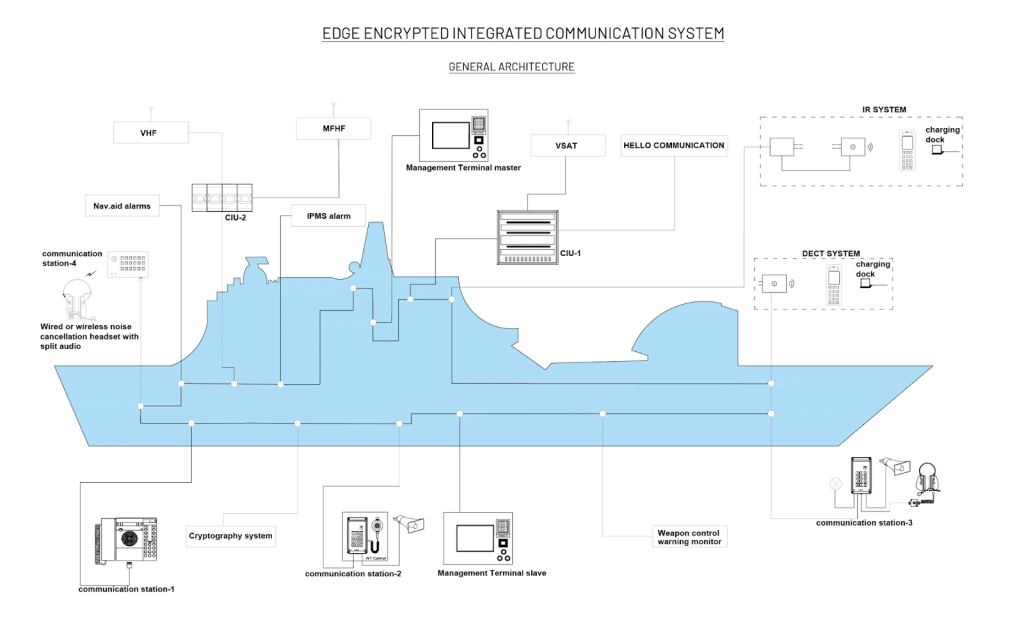
Customized design for vessel types
Whether it’s a large ship requiring numerous integrated navigation and communication devices or a small vessel carrying a minimum load and crew members, we offer customization capabilities for each vessel type. Similarly, for merchant navy ships, we can configure communication devices with intensive encryption or efficient noise-reducing paging systems for offshore platforms. Every challenge with the onboard communication systems can be tailored to fulfill your requirements.
Hardware from globally certified OEMs
Every component used in the manufacturing of communication and navigation devices is sourced from globally certified OEMs. Whether it’s a marine crew alert system, PA/GA systems, marine intercom systems, voice speakers, or handsets, every equipment is designed to ensure its reliability, durability, and performance in diverse weather conditions across the oceans.
Full commissioning and lifecycle support
Edge offers a complete cycle of service, from installation, quality checks, training of the crews, to maintenance, the services guarantee lifelong support. The Edge In Control, when used as a ship communication system, promises to optimize its capabilities according to the future scaling requirements as well.
Experience in integration with IBS, Automation, and Safety systems
With seamless integration capabilities, the internal ship communication Edge In Control is embedded with high-quality PA/GA systems and alarm sets that adhere to Edge’s internal communication system, which adheres to IBS (Integrated Building Systems) or Building Management Systems (BMS), SCADA, automation, and safety systems.
Testimonials or project highlights
The Edge In Control’s PA/GA systems and vessel intercom system UAE / Saudi Arabia / India have delivered quality performance across different types of vessels or ships. From offering disturbance-free voice and sound signals across the large navy ships or offering multilingual broadcasting for passengers in cruise ships, our success rate with onboard internal communication systems for ships is continuously increasing.
Future Trends in Onboard Communication
Industry-wide digitalization and automation have improved the communication capabilities of the maritime industry. As a result, the global marine onboard communication and control systems market was estimated at USD 9.4 billion in 2024 and is expected to grow at a CAGR of 7.8% during the period of 2025-2034. In the future, a number of trends are expected to dominate the area of maritime communication.
IP and wireless crew communication
The development across the IP-based systems is gradually replacing older communication methods and systems that operated on fragmented methods across different isolated technologies. This will lead to a single network that accommodates voice, video, and data services. Meaning, a ship can use IP-based PAGA (public address and general alarm) systems, intercom systems, and CCTV by installing all parts on a single IP Network. The introduction and growth of wireless technologies such as Wi-Fi, 5G/6G, and satellite networks are also relied on to provide crew connectivity and access to streaming services and data applications.
AI-powered voice diagnostics and alert monitoring
The emergence of autonomous ships will rely on communication systems that are AI-powered. AI algorithms use data from IoT sensors (vibration, temperature, etc.) to analyze and predict equipment failure, allowing for preventative maintenance and fewer breakdowns. AI will deliver better reliability by filtering out the noise and worrying about critical alerts. This gives crews the ability to detect issues and risks and respond proactively before the emergency worsens.
Cloud connectivity for remote diagnostics
Maritime companies will leverage cloud computing platforms and big data analytics to review and analyze large volumes of data collected from the ships, ports, and other maritime assets. A cloud-based solution creates a storage platform, collaboration platform, and enables access to information (anywhere/anytime), improving productivity, decision-making, operational efficiencies, and cost.
Conclusion: Investing in Safety Through Smarter Internal Communication
A solid internal communication system is the backbone of any type of vessel. It acts as a protective compliance shield for the crew members, passengers, marine engineers, and other important equipment and materials onboard. Core components such as marine intercom systems, PA/GA systems, alarm systems, talk-back, and voice recording and logging systems establish effective communication from the bridge, engine rooms, crew quarters, or cargo zones.
Further, with Edge In Control, the businesses can tap into seamless and reliable communication on the high seas through dynamic marine internal communications systems. It comes with benefits to customize all the core equipment according to the requirements related to size, amplification, safety, compliance, and environments. Most importantly, all the products used in the manufacturing are certified by global OEMs and follow the industry-based best practices during fabrication.
The voyage for safer and more efficient communications starts here. Explore how Edge in Control can be your preferred partner for onboard safety systems. Or contact us to know more about the internal communication system for ships and book a system design consultation for your onboard communication for your vessel.
FAQs
1.What type of internal communication systems do large vessels use?
Large vessels have vast areas for communication. They use effective PA/GA systems, alarm units, voice recorders, talk-back systems, and other internal communication devices with add-on amplifiers, speakers, and noise cancellers to transmit announcements and sound effectively in every zone of the vessel.
2. Can we use the same internal communication equipment on different vessel types?
Yes, you can use the same internal communication devices for various vessel types, such as a merchant ship, a cruise, a fishing boat, etc. However, its size, compactness, performance, and operational efficiency may differ based on the requirements of each vessel type.
3. What are the benefits of using Edge In Control of internal ship communication?
Edge In Control has more than a decade of experience in offering products and services for onboard or internal ship communication. It offers customization for each vessel type and uses parts or equipment approved by global OEMs. It integrates with modern IBS, automation, and security systems, and provides full-cycle support for its systems.